
How Journalists Can Overcome Professional Burnout and Build Support
Journalism is one of those professions that has a high risk of burnout.
Burnout is a systematic problem, therefore it requires systematic solutions that depend on various participants in the process: management (editorial staff), the team and the journalist himself. Along with the fact that professional burnout is a significant problem and can cause difficulties in the field of physical and mental health, negatively affect all areas of life, in particular, lead to a decrease in the quality and productivity of work, it is important to focus not only on "firefighting" - overcoming the consequences of burnout, but also "planting a forest" - cultivating an atmosphere and corporate policy of the editorial office that leads to "burning out" - psychological flowering, well-being of employees.
What is professional burnout?
This is a psychological state associated with feelings of exhaustion, loss of enthusiasm, and the development of a negative perception of one’s productivity or work in general, as well as of colleagues or those with whom one interacts. Burnout is a chronic depletion of an individual's energy resources, manifesting as a prolonged feeling of emotional exhaustion, physical fatigue, and cognitive weariness. In the absence of an appropriate response, all of this can lead to serious mental health disorders (such as depression, anxiety disorders, or alcohol abuse) or physical ailments (increasing the risk of cardiovascular and musculoskeletal diseases).
There are a number of objective reasons that increase the risk of burnout among journalists.
How do we recognize burnout?
The first step in burnout is a sense of diminished efficacy: all achievements seem insignificant or mundane, and any new project or task appears overwhelming and/or not worth the effort.
The second step is a state that can be summarized as "leave me alone." A person becomes distant, ignoring both their own needs and the needs of others. They minimize contact, and when it comes to work matters, indifference and reduced engagement in professional events become dominant.
At this same stage, emotional and psychophysiological symptoms become particularly noticeable: a lack of energy, impaired memory, a marked decrease in concentration, sleep disturbances, changes in eating habits, a depressed mood, and a reluctance to start anything new or even move forward at all.
Some might think that burnout is solely the responsibility of the individual—that they are either weak or don't know how to care for themselves properly. But in reality, this is one of the common misconceptions about burnout: the social context influences us more than we often care to admit. Therefore, paying attention to and contributing to the creation of a work environment that promotes employee well-being is crucial.
Key factors of stress at work are:
-
Toxic atmosphere (characterized by sexism, racism, ageism, mobbing, and/or active or passive aggression);
-
Incorrect management (disproportionate demands relative to employee capabilities, poor organization or working conditions, inadequate compensation, irregular work schedules).
Of course, other factors also play a role:
-
Individual personality traits (perfectionism, self-criticism, hyper-responsibility, constant dissatisfaction, and evaluating everything as "not the way it should be");
-
The presence or absence of support resources, and the extent to which work values align with personal values.
Professional burnout is a significant problem; it empties a person and "suffocates" them with apathy, leading to a loss of psychological balance and a decline in work capacity. It can cause issues in both physical and mental health, affecting all areas of life. For organizations, employee burnout is linked to decreased quality and productivity, a disrupted psychological atmosphere within the team, loss of personnel, and high staff turnover.
Therefore, burnout is a state, not a mental disorder. In turn, systematic problems like burnout require systematic solutions that depend on various participants in the process: the employer, the team, and the employee themselves. Below, we propose exploring what is within the power of a manager/editor, the team, and the journalist to prevent or overcome burnout.
What can a manager/editor do?
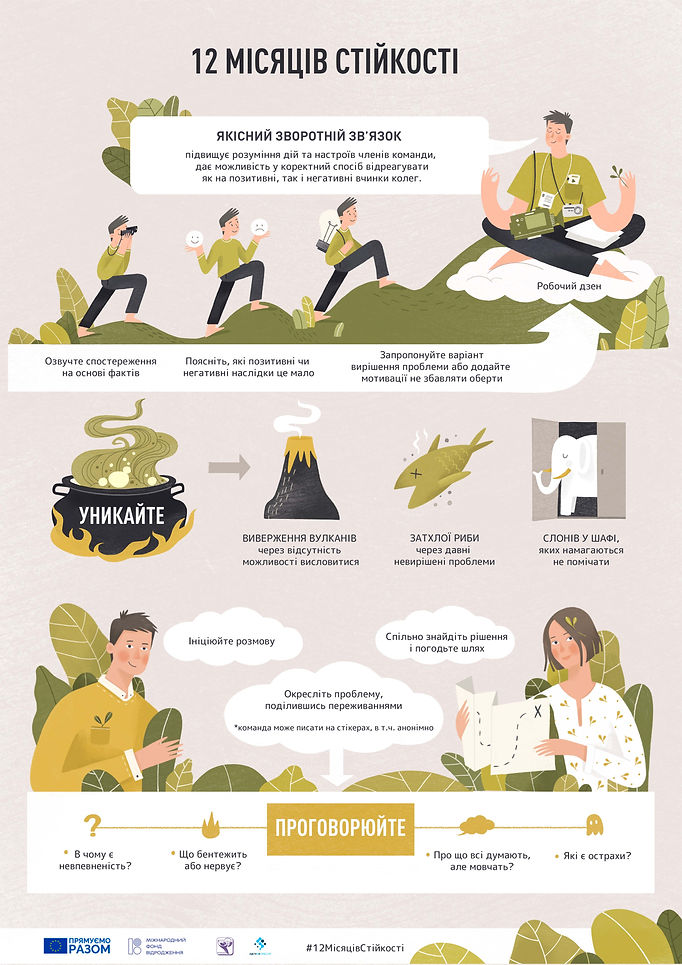
Give a sense of freedom of choice:
when an employee knows that what he does matters and has the freedom to choose how to do it. He also knows that he is an important part of something bigger. A good manager values a person and their work, makes sure that no one is left unnoticed. A good manager helps to measure results and impact, showing progress in development, and also helps to see the big picture. And not the least role in this is played by the ability to provide quality feedback regularly. Below we offer one of the possible options.
Offer training to raise awareness about mental health, specifically providing instruction on resilience and protection against psychological trauma, the ability to recognize symptoms of traumatic stress in oneself, and how to interact correctly with those who have experienced it. Novice journalists are often unaware that they are unprepared to face trauma until they have the experience. Psychological trauma makes a person more vulnerable to burnout, depressive disorders, post-traumatic stress disorder, and unhealthy coping mechanisms.
In addition to training, it is important to provide employees with 24/7 psychological support hotline numbers and inform them about employee assistance programs (EAPs).
Share experiences and create an environment where journalists feel safe speaking openly about emotional stress. To achieve this, it is essential to build an internal newsroom culture that destigmatizes psychological needs and experiences while encouraging further learning related to mental health.
Review employee workload and engagement — ensuring there is still "life outside of work."
Review the employee's level of compensation. Two points are important here: while the specific salary level does not directly determine the risk of burnout, and money is not a guarantee of high motivation, compensation must be fair and adequate relative to the effort expended. According to research, focusing primarily on the financial aspect of work reduces creativity and overall job satisfaction. However, employees can only afford not to focus on money when their basic income needs are fully met.
What is the team/community capable of?
Become a support system and a source of external resilience for one another. Create "peer-to-peer" support groups—meetings that involve the exchange of knowledge, experience, or practical assistance among people facing similar challenges. Such meetings should be held regularly and follow a specific interaction format. Research indicates that these groups enhance a participant's ability to cope with difficulties and increase psychological competence and resilience.
An important point is that peer groups do not necessarily have to be formed within your specific team or newsroom. Often, journalists find it more comfortable to participate in a mutual peer-to-peer support group established at the community level—among journalists from other outlets and freelancers. In this way, participants can feel freer to discuss the difficulties arising in their professional activities. This is particularly appropriate if a journalist is a newcomer to a team, does not feel safe discussing mental health topics internally, or does not belong to a specific editorial office (freelancers).
In 2021, the "12 Months of Resilience" program was launched with the goal of establishing a tradition of mutual aid groups specifically for journalists. The aim is to jointly seek answers to professional challenges and provide mutual support in a safe environment.
The basic principles for organizing a peer group meeting are illustrated below.

What can we personally do to prevent burnout?
-
Increasing Job Satisfaction.
This is possible when:
-
Work is meaningful: What is the meaning of your work—for you personally and for others?
-
Work is interesting, yields good results, and offers rewards: Do you celebrate your successes?
-
Work is relatively safe and does not cause harm: Do you possess stress management skills tailored to your professional context?
-
Work is performed skillfully: Do you refine your craft and acquire new knowledge or skills?
-
Working conditions are good: Do you ensure your workspace is comfortable and pleasant?
-
Working within a good team: What do you do to strengthen relationships with your colleagues?
-
The work we love is not a burden: It is a source of joy and inspiration; with a manageable workload, it also becomes a source of professional development.
-
Regulating Energy Expenditure and Recovery.
It is crucial to manage your energy not just on weekends or during vacations, but every single day. The more difficult the period (at work or in life in general), the more pleasant activities that bring you joy should be included in your daily routine. Rest is not a waste of time; it is an investment in your well-being. Breaks during work are not distractions; on the contrary, they provide an opportunity to improve your focus.
-
Possess basic stress management techniques and, most importantly, apply them. The simplest ones that can be used anywhere are physical activity and breathing.
-
Physical activity—any kind, even for just a few minutes—regulates the physiological consequences of stress (the chain of reactions triggered by overactivated brain regions and the release of stress hormones) and promotes recovery. Physical activity is a natural antidepressant and improves one's emotional state.
-
Deep mindful breathing reduces tension and the stress response. Just five deep breaths and longer exhales will make you feel better. In particular, it is recommended to inhale, hold your breath, and exhale while counting to four at each stage (during the inhale, the hold, and the exhale).
At the same time, we recommend completing a full course on self-regulation and stress management techniques to acquire a wider range of tools and choose those that suit you best depending on the circumstances. Being familiar with rules of conduct in situations involving potential trauma (working on a difficult topic or with people who have experienced psychotraumatic events) will allow you to be more mentally resilient.
-
Personal safety first If you recognize your own condition based on the professional burnout symptoms described above, seek help from a specialist and ensure you get an extended period of rest. We can only care for others when we are capable of caring for ourselves.
Regarding self-care: looking after your mental health is not difficult. The key is regularity and variety. To assist you, we offer a self-care checklist calendar with a list of simple and effective activities.

In 2021, the “12 Months of Resilience” program was launched, the goal of which is to start a tradition of creating self-help groups among journalists. To jointly seek answers to professional challenges and support each other in a safe environment. You can read the participants' feedback at the link .
Recommendations for the Independent Media Council were prepared by:
-
Anastasia Nizhnik, psychotherapist-consultant, co-founder of the BrainCult Development and Psychotherapy Center and the Resilience Hub platform;
-
Andrii Sydorenko, coordinator of mental health programs for journalists at the Suspilnist Foundation, co-founder of the Resilience Hub platform.